
Manual triage, queues, and tribal knowledge.
WHY GAUSSIQ
Built by operators who lived enterprise support at scale.
GaussIQ did not start as an AI experiment looking for a use case. It started with decades of operating experience across enterprise support, customer success, services, renewals, and global post-sales organizations. We built GaussIQ because support deserved the same level of intelligence, investment, and execution discipline as the rest of the enterprise.
We have seen the same pattern repeat across companies and growth stages: workflow improves, systems multiply, dashboards expand, but execution still breaks.
Enterprise scale
We have led global support, success, services, and operations teams through growth, transformation, integration, and turnaround environments where execution depends on coordinating people, systems, and workflows across the business.
Post-sales depth
We understand how support, customer success, services, renewals, and education actually operate together, and where execution breaks when ownership, skills, systems, and accountability become fragmented.
Execution discipline
We have built the operating models, escalation governance, capacity plans, metrics, and cross-functional mechanisms required to turn support insight into repeatable execution.
WHAT DECADES IN SUPPORT TAUGHT US
Every era improved something. Each one created a new execution challenge.
We have experienced enterprise support through multiple eras: human-driven queues, ITIL standardization, knowledge management, workflow automation, SaaS customer success, chatbots, copilots, and now agentic AI. Along the way, initiatives like self-service and shift-left support improved access to answers, but they did not solve the deeper execution problem.
Each era improved part of the system. But each also created a new coordination challenge.
ITIL, process discipline, and workflow systems.
Knowledge, self-service, chatbots, and copilots.
More agents, more systems, and harder coordination.
As support becomes hybrid human + AI, the bottleneck is no longer just response time, knowledge access, or ticket workflow. The bottleneck is execution: determining the right plan, the right skills, the right owner, and the right learning loop across fragmented systems.
WHAT WE SAW
The problem was never just ticket handling.
Enterprise support breaks when knowledge, ownership, priority, skill, customer context, and business impact are scattered across systems and teams.
In real support environments, the hardest decisions are rarely contained inside one workflow. They sit between systems of record, product signals, customer history, engineering capacity, support skill depth, and commercial risk.
Execution breaks when teams cannot answer:
- What is the right response plan?
- What skills are actually required?
- Who is the best-fit owner?
- What customer or business context changes the priority?
- What should the organization learn from the outcome?
WHY THIS TEAM
We have operated where support becomes strategic.
Our founding team has worked inside the environments GaussIQ is designed to improve: complex support operations where services, success, product, engineering, and customer commitments must coordinate across systems, teams, products, and customer segments. We have run global services businesses, rebuilt support models, scaled customer success organizations, integrated acquisitions, improved retention and customer satisfaction, and created operating systems for cross-functional execution.
We know the operating model.
Support is not a queue. It is a delivery system that must coordinate people, skills, knowledge, product signals, customer commitments, and executive expectations across fragmented operating environments.
We know the organizational reality.
Most enterprise support organizations still rely on tribal knowledge, manual coordination, informal escalation networks, and a handful of deeply experienced people to bridge gaps between systems, teams, and workflows.
We know the data challenge.
The data usually exists, but it is fragmented across ticketing systems, CRM, knowledge bases, telemetry, workforce tools, product systems, and customer success platforms.
We know the executive pressure.
Support leaders are asked to improve customer experience, reduce cost, protect renewals, increase efficiency, and become more strategic without a system that helps them execute across silos.
WHAT WE LEARNED
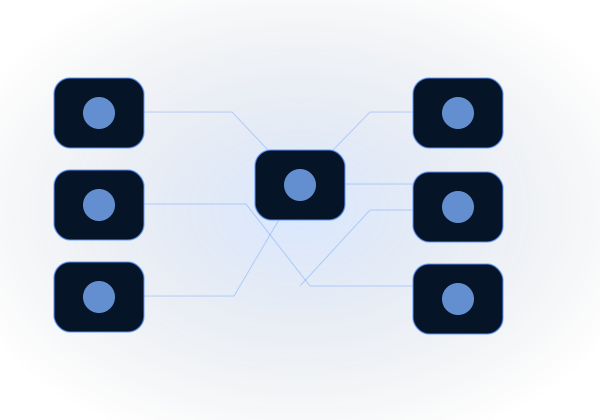
Tools optimize pieces. Execution requires a coordinating layer.
Ticketing systems track cases. Knowledge systems store answers. Workforce tools plan staffing and coverage. Analytics describe what happened. Copilots assist with tasks.
But none of those systems consistently determine how work should be executed across the support lifecycle. That is the gap GaussIQ was built to close.
Response plan first. Infer the required skills. Route to the best-fit owner. Learn from the outcome.
OUR POINT OF VIEW
Enterprise support does not need another dashboard. It needs execution intelligence.
GaussIQ is built on a simple belief: when support work begins with the right plan, the right skills, and the right owner, teams can reduce rework, improve resolution quality, expose hidden friction, and create a learning loop that compounds over time.